
How to Get Court Records
Figure out which Monroe County court keeps the case before anything else. From there, the path is simple. The public register at MiCOURT Case Search shows public Monroe County C38 or D01 information, and the clerk who holds the file can supply the underlying court record. To request it, Monroe County gives you several routes. You can visit the clerk in person. You can call and get routed, mail a written request, or use a drop box where one is accepted. Court-approved electronic requests work when the court permits them. Certified copies are available on request. Under Monroe County's joint order, the register may sit on a public website while other public information gets provided electronically upon request.
- Identify the Monroe County court code and preserve the complete case number, or collect the party names if no number is known.
- Decide whether you need to review a Monroe County file, obtain ordinary copies, request a specific record, or seek certification.
- Use the 2025 Monroe County joint request form and access order to describe the case and request.
- Submit through the responsible Monroe County clerk's accepted channel and call first if a mail, drop-box, or electronic route is unclear.
- Confirm any Monroe County copying or certification charge with the clerk before relying on a cost or timing expectation.
Monroe County Court Records and the 2025 Joint Order
Monroe County Administrative Order 2025-01J sets the current rules. They cover access to, inspection of, reproduction of, and creation of court records across the C38, D01, and P58 courts. It replaced the earlier 2020 access orders. The order rests on MCR 8.119(H) and MCR 8.110(C)(8). If you fill out the Monroe County request form, be ready to give the date and your contact details. Give a complete case number or party names. Say whether you want to review the file or get copies. The form also lets you ask for the whole file minus nonpublic records, or name just the specific records you need. Michigan Court Rule Chapter 8 lays out the statewide framework the local order follows, so read it for the full rule text behind any Monroe County docket request.
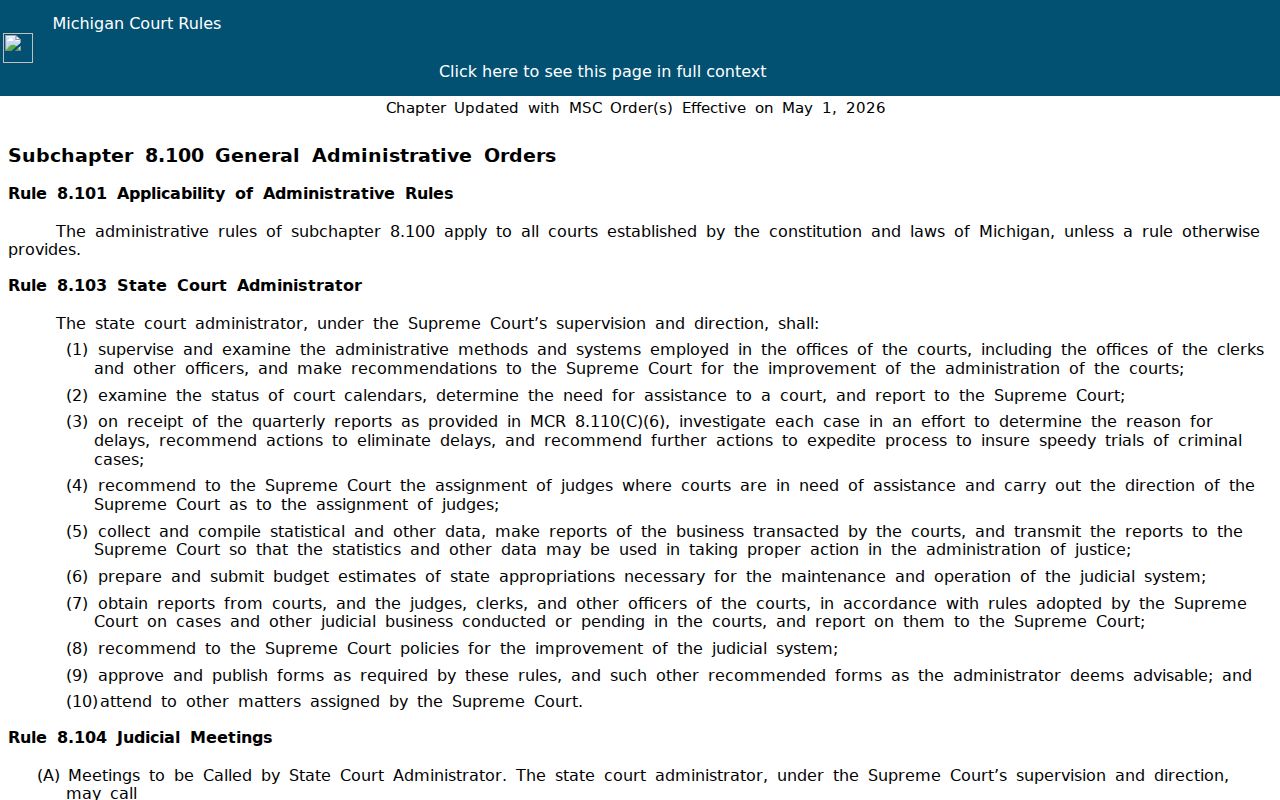
That Monroe County order sits inside Michigan's larger court-record rules. Sealed, nonpublic, and redacted material stays off limits no matter how a request is framed.
Types of Court Records
What kind of Monroe County court record you want shapes both where it lives and how much of it the public can see. Register information that Monroe County makes public covers case type, status, parties or their roles, dates, and public events. The clerk-held file goes deeper. Pleadings, motions, signed orders, judgments, and other filed material may all sit inside it. A public search does not promise that every document is online or copyable. So be specific. Ask for a Monroe County record by name and date range whenever you can. Otherwise the clerk has to guess.
- Monroe County D01 civil, small claims, misdemeanor, traffic, and civil-infraction case records.
- Monroe County C38 civil, felony trial-level, appeal, and Family Division records.
- Monroe County Probate records involving estates, wills, guardianships, conservatorships, and related matters.
- Monroe County public registers of actions and scheduled-event information.
- Monroe County signed orders, judgments, pleadings, motions, and copies allowed under the applicable rule or order.
Monroe County Court Records Clerk Map
Monroe County splits its court records across several desks, so knowing which office holds your file saves a trip. The Monroe County Clerk also serves as Circuit Clerk for C38. District D01 records sit with that district's clerk offices, and Monroe County Probate Court keeps its own public contact. Family Division belongs to C38. Juvenile records stay restricted. They are not part of a routine public search. For D01 and C38 court-office information, Monroe County uses 106 East First Street, while 125 East Second Street serves as the public courthouse address on county pages. Call ahead to confirm the right entrance before you visit any Monroe County office.
38th Circuit Court and Monroe County Clerk
106 East First Street
Monroe, MI 48161
734-240-7020
Monroe County 1st District Court
106 East First Street
Monroe, MI 48161
General 734-240-7075; criminal and traffic 734-240-7076; civil 734-240-7090
Monroe County Probate Court
Public-access instructions are available from the Probate clerk.
734-240-7346
What a Court Record Contains
A Monroe County case record is more than a search-result row. What sits inside depends on the case and what counts as public. In general, the Monroe County clerk's file holds the chronological register plus the documents filed or entered in the proceeding. Read each filed record for its own wording, its date, and its court. The wording matters. A motion is only a request for Monroe County court action, while a signed order is the court's directive, so an event label alone does not tell you how a ruling came out.
| Case number and court | The Monroe County court-assigned identifier and C38, D01, or P58 context used to route a request. |
|---|---|
| Register of actions | Chronological Monroe County public case activity where available, including filings and events. |
| Pleadings and motions | Monroe County documents submitted to seek or respond to court action, subject to public-access limits. |
| Orders and judgments | Filed Monroe County court rulings or decisions; certification must be requested from the responsible clerk. |
| Protected material | Sealed Monroe County documents, redacted identifiers, and confidential material may be absent or withheld. |
Monroe County Court Records: Review Versus Copies
Monroe County's 2025 request form draws a line between looking at a case file and getting copies. That distinction matters. It lets a requester tell the Monroe County clerk whether inspection alone will answer the question or whether a specific document, order, or set of pages is what's needed. The form also separates two kinds of request. One covers the complete case file, excluding nonpublic records. The other covers particular Monroe County court records. One more limit applies. A Monroe County case record cannot leave the court without a court order, so review always follows clerk directions and the current local order.
| Request choice | What to identify | Practical limit |
|---|---|---|
| Review case file | Monroe County court, complete number or parties, and the purpose of the inspection. | The Monroe County clerk controls access to public material and file handling. |
| Obtain complete public file | Monroe County case identifier and the request for all material except nonpublic records. | Monroe County copies are subject to fee and restriction review. |
| Obtain specific records | Monroe County document name, event date, and date range whenever known. | Clear descriptions reduce the risk of receiving the wrong Monroe County record. |
Certified Copies and Fees
An ordinary Monroe County copy is not the same as a certified one. Certification is a clerk-authenticated copy. You must request it from the office holding the original court record. The current Monroe County joint request form carries a court-use line. That line lists copies at $1 per page. Separate Monroe County fee materials list certified copies of orders at $10 plus $1 per page, and certified judgments of divorce at $20. If a fee is not clearly listed for the record you want, don't guess. Confirm the amount with the clerk first.
| Item | Published amount | Source note |
|---|---|---|
| Copies from the joint court-record request form | $1 per page | Shown on the Monroe County form's court-use line. |
| Certified copy of an order | $10 plus $1 per page | Monroe County fee-schedule example; confirm the current charge. |
| Certified judgment of divorce | $20 | Separate Monroe County fee-schedule line; use the proper certified-copy route. |
Monroe County Court Records Certified-Copy Routes
Certified copies start with the clerk who keeps the court file. That is where a certified court order or other certified court record comes from. Divorce judgments work differently. So do certified birth, marriage, and death records. Those run through a separate county certified-copies route with their own fees. Don't send a general docket-copy request to the vital-record provider. A register result can't stand in for a certified record. And a vital record isn't just one more document inside a Monroe County court docket. Monroe County's certified-copy instructions lay out the county's separate route for certified copies.
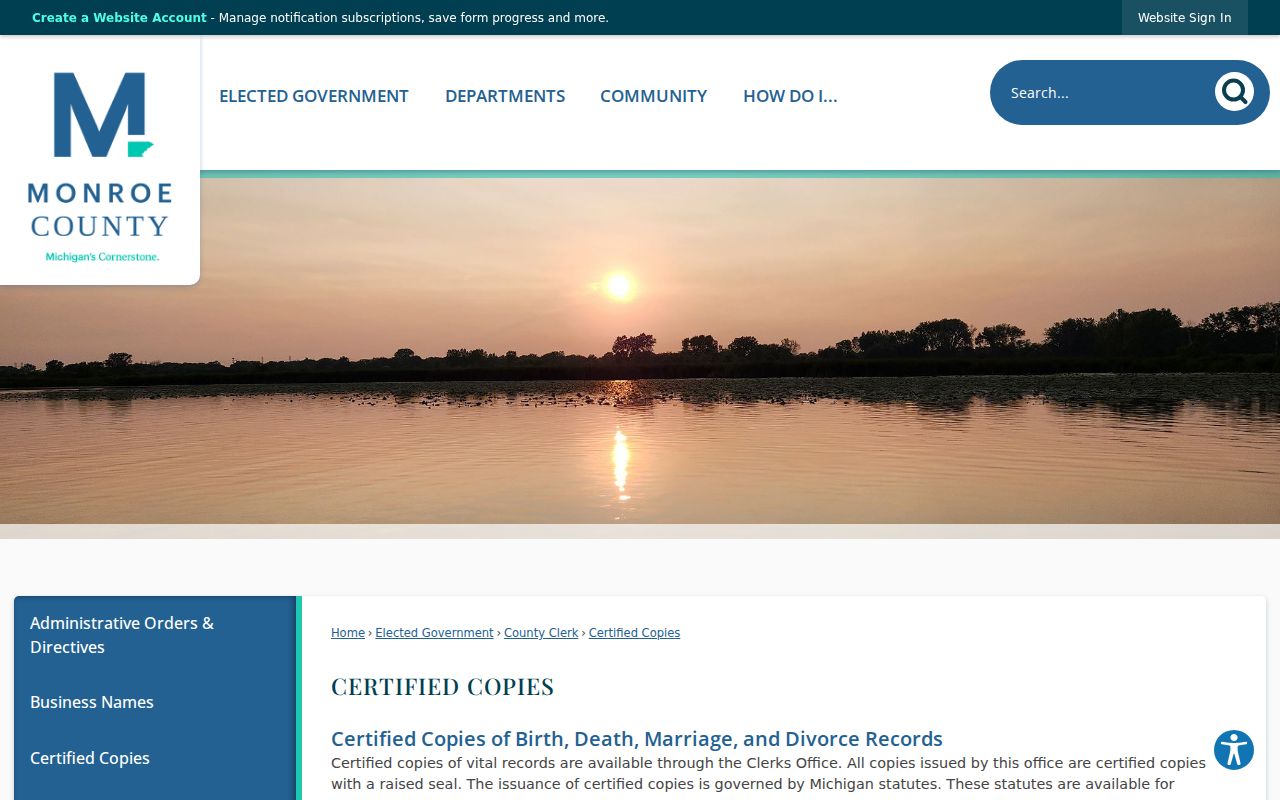
Name the record type before you ask. The Monroe County clerk can then tell you which office, fee, and certification process applies.
Monroe County Court Records Are Not a FOIA Request
Michigan FOIA is the wrong tool for Monroe County court records. The statute itself says so. Monroe County's FOIA request page covers county administrative records, not case files. Under MCL 15.232, the judiciary falls outside the ordinary public-body definition. A county clerk acting as circuit-court clerk falls outside it too. So a FOIA letter will not get you a docket or a case file. Court records run through the court's own request form. They also run through the limits set by MCR 8.119. Send the request to the court clerk who holds the file. A county FOIA channel will just bounce it back.
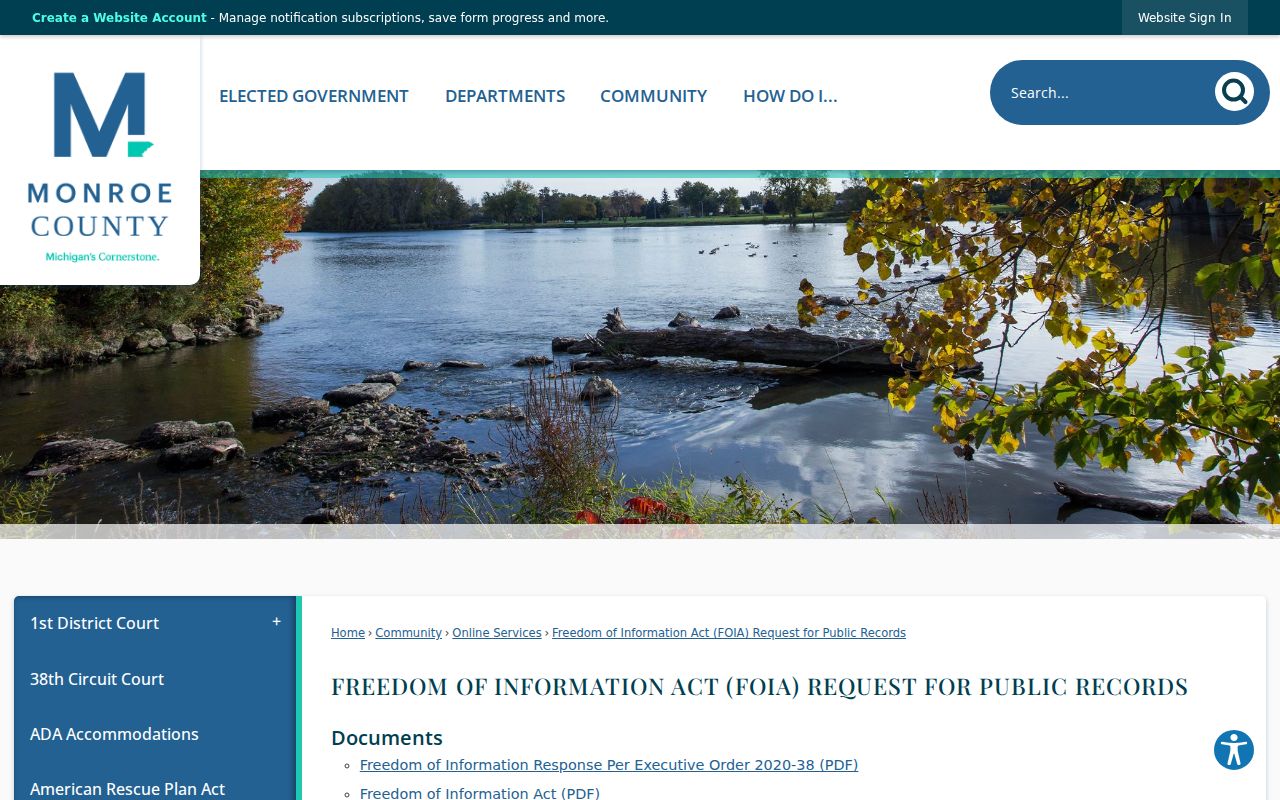
Keep the two routes straight. A request aimed at the right clerk reaches someone who can actually apply the court rules that govern the file.
Monroe County Court Records Electronic and Mail Access
Monroe County's current local order allows other public case-record information to be provided electronically on request. The county also documents in-person, mail, and drop-box options where accepted. Calling ahead helps you reach the right court. It also confirms which delivery method the clerk currently takes. The courthouse entrance has a drop box for filings and payments. But check with the responsible clerk before dropping a records request in it. Monroe County D01 civil filings are not accepted by email or fax. That is a filing rule, though. It is not proof that every records inquiry must go on paper. No official turnaround time exists for a general court-record request. The age of the record, its scope, whether it is public, and any certification you want can all shape how the clerk processes it.
Monroe County Court Records and Probate Public Access
Monroe County's Online Services page links to Probate Court Public Access at courtview.monroemi.org, though the site itself can fail to load, returning a gateway or server error. What that screen offers in the way of searches, logins, or copy requests is hard to say until it responds. When the portal is down, Probate Court can tell you the current public-access steps directly. Call 734-240-7346. You can also email probateclerks@monroemi.org. An outage changes nothing about confidentiality rules for probate or restricted records.
Public Access and Sealed Records
Michigan court records are public only as far as a rule allows. A statute or court order can set the same limit. MCR 8.119 governs case records, public registers, inspection and copies, and sealing. A companion rule, MCR 1.109, shields certain identifying information from open view. That protection covers Social Security and national-identification numbers. It also covers driver-license and state-ID numbers, passport numbers, dates of birth, and financial-account details. Juvenile case records face a further barrier under MCL 712A.28, which limits general public access. A public case name alone never authorizes disclosure of protected material inside the file.
Access boundary: Sealing under MCR 8.119 requires a written motion, good cause, and consideration of less restrictive means. Restricted records cannot be obtained by changing portals, submitting a FOIA request, or using a city administrative channel.
Monroe County Court Records Restriction Checks
Before requesting a broad set of Monroe County court records, pause. Ask what kind of matter it is. Some files face tighter limits from the start. Juvenile cases, child protective proceedings, and adoptions are among them. So are PPOs, restricted probate matters, and files with sealed attachments or protected identifiers. MiCOURT public search already leaves several protected categories out of its results. If a record turns out not to be public, the responsible clerk can explain the applicable rule. The clerk can also walk you through the motion process. Leave sensitive details out of any public request example. That means no full dates of birth and no financial-account information. It also means no driver-license data and no details about minors.